
What “Custom Guitar” Really Means?
- Dec 14, 2025
- 5 min read
Understanding the process, commitment, and intention behind a truly custom instrument
1. Why “Custom Guitar” Is Often Misunderstood Today?

The term custom guitar is more popular than ever. Social media, boutique brands, and factory-made “custom-style” instruments have made the word feel accessible — sometimes even casual.
However, through years of working with players at different stages, musical backgrounds, and expectations, a consistent pattern has emerged.
A true custom guitar is not defined by options or aesthetics, but by process, decision-making, and commitment. This guide is written to distill those long-term observations and practical experience into a clear perspective — so you can decide whether this path is right for you before starting.
2. Custom vs. Custom-Style Guitars
Not all guitars labeled custom are built the same way. Through working with many clients over time, one distinction consistently becomes clear early in the discussion.
A custom-style guitar typically refers to an instrument that is adapted from an existing platform. In practice, this often involves:
Predefined body shapes and construction methods
Limited modification options
Faster production timelines
Design decisions largely made in advance
A true custom guitar, on the other hand, begins from the player rather than a preset model. Based on our experience, this usually means:
The instrument is built around the player, not a template
Structural and ergonomic decisions are made intentionally
The design is finalized specifically for a single build
The process unfolds in sequence, not simultaneously
Neither approach is universally “better.” They represent fundamentally different ways of thinking about instruments, and understanding that difference helps players choose the path that aligns with their expectations.
3. The Role of the Player in a Custom Build
One of the most common misconceptions we encounter is the idea that a custom guitar is something you simply order.
In practice, it is something you actively participate in.
Based on years of working closely with players, the success of a custom build often depends as much on the player’s involvement as on the builder’s execution. This involvement typically includes:
Clearly communicating musical context, playing style, and tonal priorities
Making informed decisions early in the design stage
Understanding the trade-offs between design, tone, and ergonomics
Committing to key choices as the build progresses
A custom guitar is a collaboration between builder and player — not a trial-and-error product, and not a process that can be refined indefinitely once construction begins.
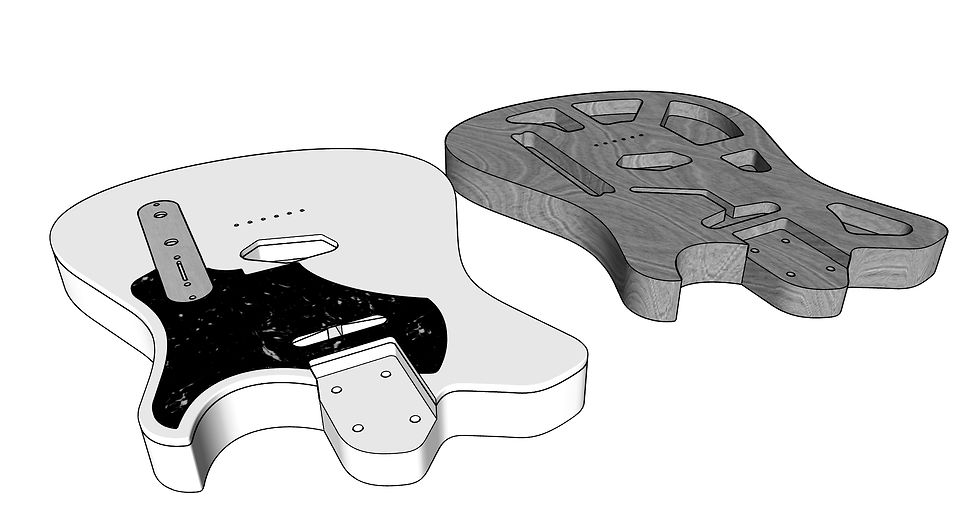
4. Design Before Wood: Why Everything Starts on Paper
Before any wood is cut, a custom guitar must exist as a clear and finalized design. This is not a formality, but a critical stage shaped by experience and technical necessity.
Over years of building instruments, we have learned that drawings and blueprints function as more than visual references. They serve as:
A translation of ideas into physical, measurable reality
A way to ensure hardware compatibility and ergonomic balance
A safeguard against irreversible structural decisions
Once construction begins, many choices become permanent. Adjustments that seem minor on paper can carry significant consequences once material is removed.
This is why the design stage often takes more time than clients expect — and why it ultimately defines the success of the instrument.
5. Time, Process, and Sequence
A custom guitar is not built all at once. Through years of responding to different client needs, revisions, and expectations, one principle remains constant: the process must unfold in sequence.
A typical custom build progresses through defined stages:
Design finalization
Material selection
Structural construction
Finishing
Setup and refinement
Each stage depends on the previous one being completed correctly. Decisions made early directly shape what is possible later — both structurally and sonically.
When delays occur, they are rarely about speed. More often, they are about accuracy, alignment, and ensuring that each stage supports the next.
A guitar built out of sequence may be finished faster, but it will never be truly custom — nor reliably consistent with the intentions that defined it at the start.
6. What Custom Guitars Can — and Cannot — Guarantee
Based on our experience building instruments for players with diverse expectations and playing styles, one important distinction often needs to be clarified early in the process.
A custom guitar can offer:
A tailored ergonomic feel that reflects how you physically interact with the instrument
A tonal response shaped around your playing style and musical context
A deeper connection to the instrument through intentional design choices
Long-term satisfaction built on clarity, purpose, and commitment
A custom guitar cannot guarantee:
That it will automatically sound “better” than every factory-made guitar
That it will feel identical to another instrument, even with similar specifications
That every expectation will translate exactly from imagination to wood
Wood is a living material, and handmade instruments reflect that reality. Variation is not a flaw to be eliminated, but a characteristic to be understood and respected.
7. Commitment Is Part of the Craft
One of the most important — and least discussed — aspects of custom guitars is commitment. This understanding usually develops not from theory, but from experience on both sides of the process.
Once certain stages are completed:
Structural changes may no longer be possible
Late revisions can affect timeline and cost
Reversing earlier decisions may compromise the integrity of the build
These realities are not limitations. They are part of what gives custom instruments their character, clarity, and honesty.
A custom guitar ultimately reflects decisions made with intention — not hesitation — and that intention is embedded in the instrument long after the build is complete.
8. Who Custom Guitars Are Really For?
Over time, working closely with custom clients reveals recurring patterns — not tied to skill level or genre, but to how a player approaches the instrument and the process itself.
Custom guitars tend to resonate with players who:
Value the journey as much as the result
Have a defined musical direction and purpose
Embrace the natural nuances of handmade instruments
Are comfortable committing to deliberate, long-term decisions
They are often less suited to players who are primarily looking for:
Immediate turnaround
Open-ended or constantly evolving revisions
Exact replicas of existing instruments
Design choices driven by short-term trends
Recognizing this distinction benefits both builder and player. It keeps the process focused, the expectations aligned, and the final instrument true to its original intent.
Custom Guitars vs. Mass-Produced Guitars
Aspect | Custom Guitars | Mass-Produced Guitars |
Design Starting Point | Begins with discussion, sketches, and a finalized blueprint developed for one specific build | Begins from a predetermined design created for repeatable production |
Design Approach | Built from the player’s needs, measurements, and musical context | Built from standardized templates proven to appeal to a broad market |
Role of the Player | Active — the player participates in shaping the design | Passive — the player chooses from existing models and options |
Design Flexibility | High, but defined early to ensure structural coherence | Limited to predefined variations within the model |
Purpose of the Design | To serve a specific player through intentional decisions | To efficiently reproduce popular and consistent models |
Neither approach is inherently better. The right choice depends on the player’s needs, expectations, and musical vision. This difference in design process shapes not only how the guitar is built, but how the entire experience unfolds.
Closing Thoughts
A true custom guitar is not about having more options. It is about making fewer decisions — made with greater intention.
Understanding what custom really means is the first step toward an instrument that feels honest, personal, and enduring. This clarity helps set realistic expectations, encourages thoughtful choices, and allows the building process to unfold with purpose.
If this process resonates with you, you may be ready for a custom guitar — not just in form, but in mindset. When that readiness is clear, the build starts with a conversation.


Comments